 Inspections
How to tell if a door is a fire door: the signs to check
If you have ever looked at a door in a corridor, a flat or a rental property and wondered whether it is actually a fire door, you are not alone. Knowing how to tell if a door is a fire door comes down to evidence rather than appearance: a certification label or plug on the edge of the leaf, intumescent strips and smoke seals, a self-closing device, a proper set of hinges, and paperwork that ties the door back to a tested and certified product. No single feature proves it on its own, but together they tell you whether a door can be relied on in a fire.
This matters because a fire door is only useful if it performs as tested. Anyone acting as the responsible person under the Regulatory Reform (Fire Safety) Order 2005 needs to know which doors in their building are fire doors, and that those doors are kept in working order. This guide covers the signs an inspector looks for, why a door that looks the part may not be a fire door at all, and what to do if you cannot find any evidence.
How to tell if a door is a fire door: a quick checklist
A genuine fire door will usually show most, if not all, of the following:
- A certification label or colour-coded plug, usually on the top edge of the leaf and sometimes on the hinge edge.
- Intumescent strips, often combined with smoke seals, fitted in the edge of the leaf or in the frame.
- A self-closing device that closes the door fully from any open position.
- Usually three hinges, of a type suitable for fire door use.
- A solid, heavy leaf, typically thicker than a standard internal door.
- Fire-resistant glass with a permanent mark, if the door is glazed.
- Appropriate signage, such as Fire Door Keep Shut.
- Records showing what was installed, when and by whom.
The label and the paperwork are the strongest evidence. The rest are supporting signs with limits of their own.
Certification labels and colour-coded plugs
Fire doors are commonly covered by third-party certification schemes, such as BWF-Certifire or BM TRADA Q-Mark. These schemes mark the doors they certify with a label or a small plug set into the edge of the leaf. The top edge is the most common position, so you may need a step ladder to find it, and some schemes place the plug in the hinge edge instead.
Plugs are often colour-coded. Depending on the scheme, the colour of the plug, and in some cases its central core, indicates the fire rating and other details, such as whether smoke seals are required. The codes differ between schemes, so a plug should be read against the relevant certification body's published key rather than guessed at. Many labels also carry a unique number that allows the door to be traced back through the scheme's records.
These fire door markings are easily lost. They get painted over, removed when a door is trimmed or planed, or simply fall out. A missing label does not automatically mean the door was never a fire door, but it does mean the door can no longer prove what it is on its own.
Intumescent strips, smoke seals, closers and hinges
Look along the edges of the leaf and the inside of the frame. Most fire doors have intumescent strips fitted in a groove in either the leaf edge or the frame, so check both. These strips expand when heated, sealing the gap to hold back fire and hot gases. Many are combined with a brush or fin seal that stops cold smoke. A door rated FD30S or FD60S, where the S indicates smoke control, needs those smoke seals to perform as intended. The gap around the leaf matters too, and our guide to fire door gap tolerances and the 3mm rule explains what inspectors measure.
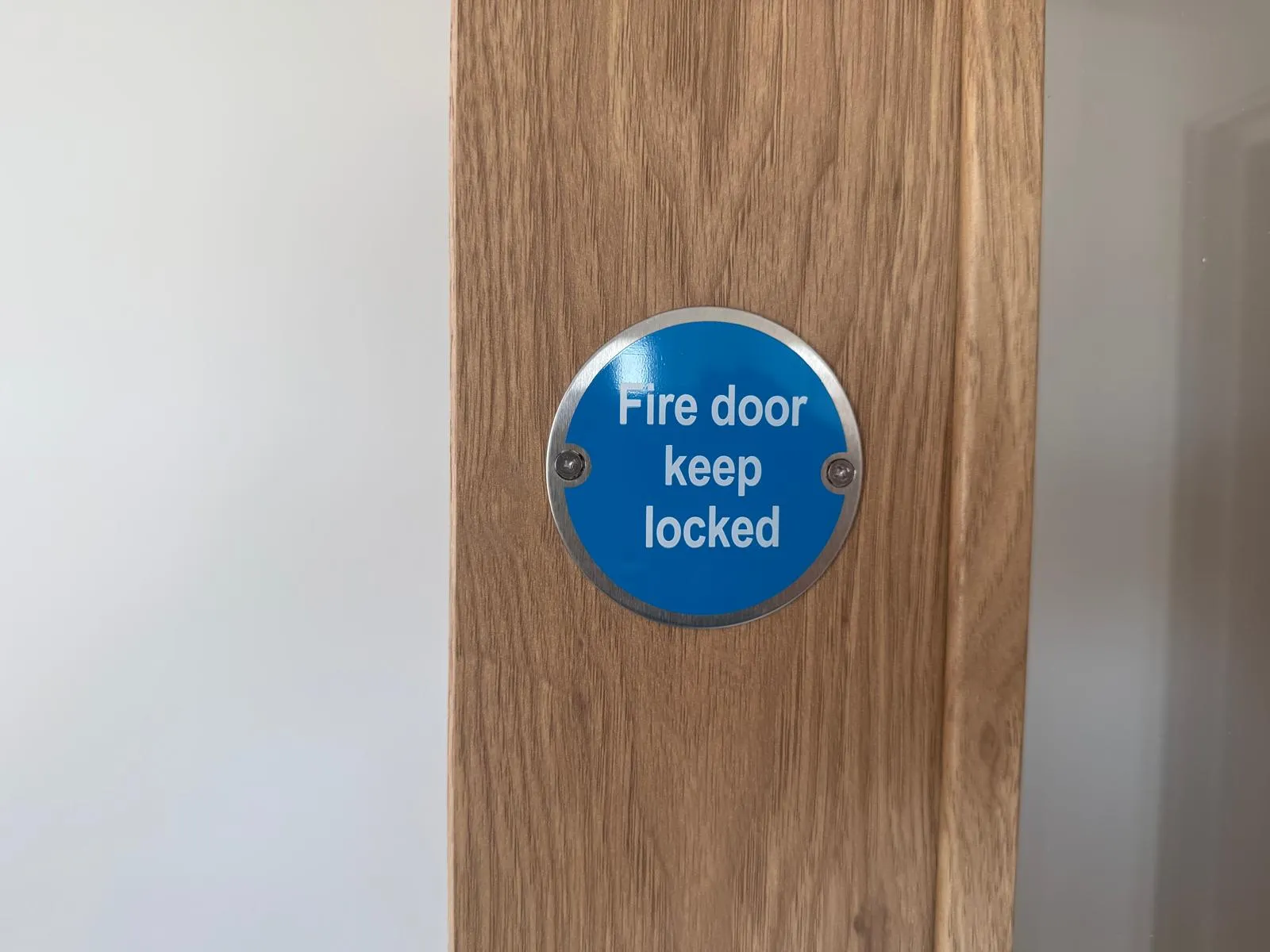
Next, check how the door closes. Approved Document B generally expects fire doors to be self-closing, with limited exceptions such as cupboard and service duct doors kept locked shut, which is where you will see Fire Door Keep Locked signs. The closer is usually an overhead or concealed device, and overhead closers on fire doors are commonly certified to BS EN 1154. Some doors are held open by a device linked to the fire alarm that releases them when the alarm sounds. Open the door fully, let it go, and watch whether it closes firmly into the frame and latches. A door left ajar is a defect, whatever it is made of.
Hinges are another clue. Fire doors usually hang on three hinges, sometimes more on taller or heavier leaves, and those hinges must match the door's certification. Two light hinges carrying a heavy door is a warning sign.
Leaf thickness, glazing and signage
Fire doors are usually noticeably heavier than ordinary internal doors, and thickness is a useful indicator. An FD30 leaf is commonly around 44mm thick and an FD60 leaf commonly around 54mm, while a standard internal door is often around 35mm. Our guide to FD30 and FD60 fire door ratings explains what those ratings mean. Treat these figures as typical, not definitive. Plenty of solid timber doors are 44mm thick with no fire rating at all.
If the door has a vision panel, look closely at the glass. Fire-resistant glass normally carries a permanent etched or printed mark in one corner identifying the product. Older doors often use wired glass, which can form part of a fire-rated glazing system, but wire alone does not prove the door or glazing meets any rating. The beads and seals holding the glass must also be part of the certified design.
Signage is the weakest evidence of all. Blue mandatory signs such as Fire Door Keep Shut tell occupants how the door should be used, and they are expected on many fire doors in common and non-domestic areas. But anyone can screw a sign to any door. A sign tells you what someone intended the door to be, not what it is.
Why a door that looks like a fire door may not be one
A fire door is not simply a door with fire safety features added. Its rating comes from the complete doorset - the leaf, frame, seals, hinges, closer, glazing and ironmongery - being tested together to BS 476-22 or BS EN 1634-1, then manufactured and installed to that tested specification. Change one part without evidence, and the rating can no longer be assumed.
That is why appearance can be misleading. Common examples include:
- Ordinary solid doors with strips, a closer and a sign added, giving the look of a fire door without any tested performance.
- Certified leaves hung in frames that were never part of the tested doorset.
- Letterboxes, spyholes, cat flaps or extra locks cut into a certified door without evidence that the change is covered.
- Leaves trimmed beyond the limits allowed by the certification to fit an out-of-square frame.
- Broken fire-resistant glass replaced with ordinary glazing.
BS 8214, the code of practice for timber-based fire door assemblies, is the benchmark a competent inspector works to when judging whether a door can be relied upon.
What to do when there is no evidence
If you cannot find a label or plug, start with the paperwork. Installation records, doorset certificates, manufacturer data and previous inspection reports can all confirm what a door is, even when it has lost its markings. In residential buildings over 11 metres in height, the Fire Safety (England) Regulations 2022 require quarterly checks of communal fire doors and annual best-endeavours checks of flat entrance doors, and those records often hold useful history. For higher-risk buildings under the Building Safety Act 2022, fire door information should also form part of the golden thread.
If the paperwork does not settle it, arrange a survey by a competent fire door inspector. A proper survey looks for hidden or painted-over markings, assesses every component of the doorset against BS 8214, and records what can and cannot be evidenced. Our guide to how often fire doors should be inspected covers scheduling future checks.
Where a door's fire rating cannot be evidenced, the safest answer is to replace it with a certified fire doorset, installed by a competent installer and properly recorded. Guesswork has no place when a door forms part of a building's means of escape.
Is my door a fire door? Getting a clear answer in Norfolk
Access Fire Doors is based in Wymondham and carries out fire door inspection, installation and maintenance across Norfolk, including Norwich, Dereham, Attleborough, Thetford, Diss, King's Lynn and Great Yarmouth, as well as Suffolk and London. Our inspections are FIRAS certified and our team is NVQ Level 3 qualified, so the answer you get about each door is based on evidence, not appearance.
Whether you are a landlord with a single HMO, a managing agent with a block of flats, or a business owner unsure what was fitted before you moved in, a survey will tell you which doors are genuine fire doors, which need repair and which need replacing.
You can read more about our fire door inspection, installation and maintenance services, or get in touch to arrange a fire door survey. You can also call 07717 751004 or message us on WhatsApp with a rough door count and building type, and we will tell you what your doors need.
The Access Fire Doors team
Frequently Asked Questions
Where is the label on a fire door usually found?
Most certification labels and plugs are on the top edge of the door leaf, and some schemes place the plug in the hinge edge instead. You may need a step ladder to see the top edge, and paint can hide a label, so look closely.
Does a thick, heavy door mean it is a fire door?
No. Fire doors are usually heavier and thicker than ordinary internal doors, with FD30 leaves commonly around 44mm and FD60 leaves commonly around 54mm, but plenty of solid doors match those measurements without any fire rating. Thickness is a clue, not proof.
Can I turn an ordinary door into a fire door by adding strips and a closer?
No. A fire door gets its rating from the whole doorset being tested and certified together, so adding intumescent strips, a closer or a sign to an ordinary door does not give it a fire rating.
What should I do if I cannot find any evidence that my door is a fire door?
Arrange a survey by a competent fire door inspector, who will look for hidden markings, check the records and assess the whole doorset. If the rating cannot be evidenced, the usual answer is to replace it with a certified fire doorset.
More Fire Door Guides
Need Professional Fire Door Services?
Ensure your Norfolk property's fire doors are properly maintained and compliant.